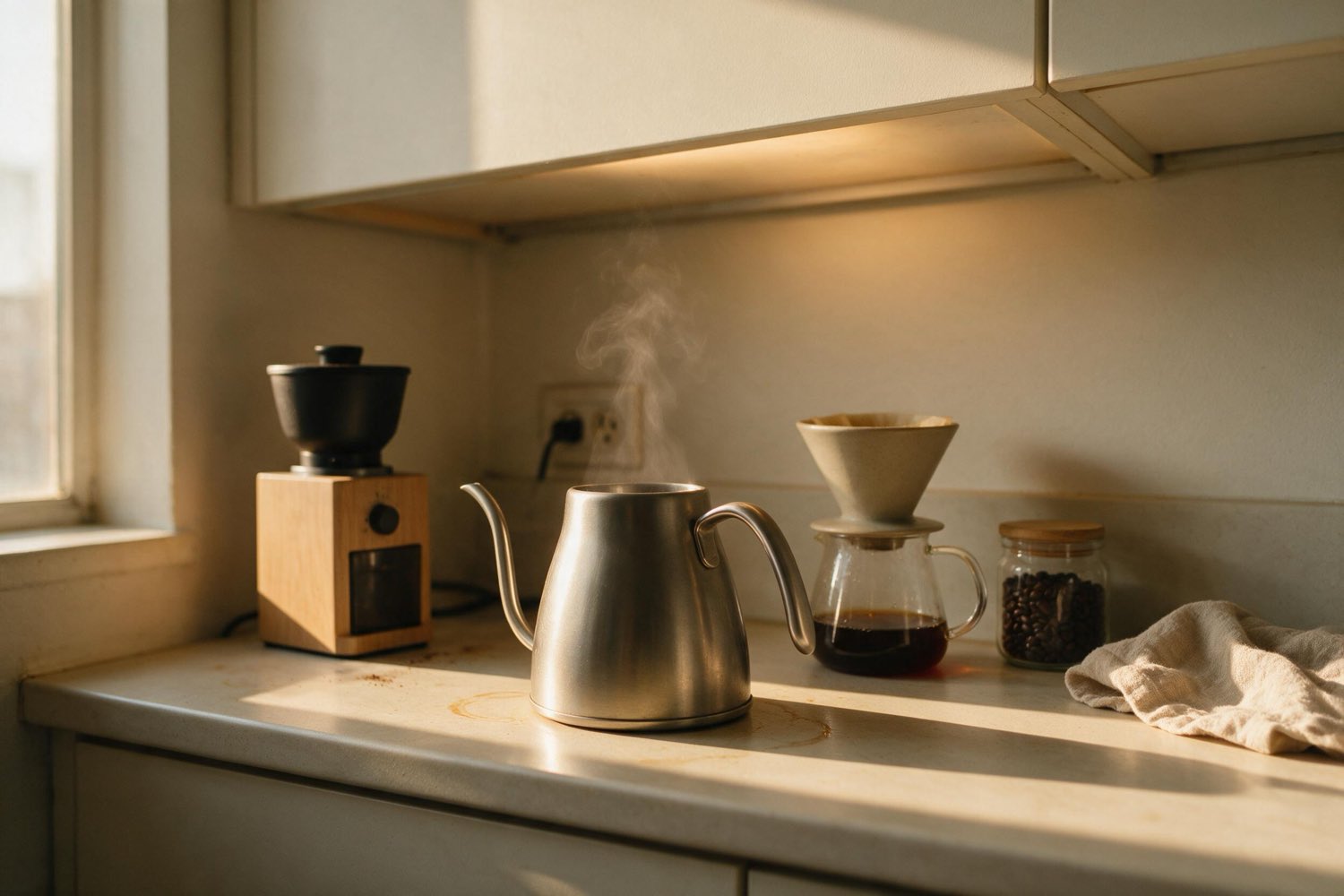
You already have a coffee setup. It is the kettle balanced on top of the microwave, the beans in the cupboard you open with your elbow, and the mug you rinse in a sink full of last night. It works. You have stopped noticing that you do not like it.
The fix is not a renovation and it is not a bigger kitchen. It is twenty-four inches of counter you are not cooking on, one outlet, and a decision about what you are actually going to make.
Twenty-four inches is a strange amount of space. Narrow enough that will this fit is a real question. Wide enough that the answer is usually yes. What follows is what fits, what to measure before you spend anything, and the two things that quietly ruin a setup after everything is already on the counter.
Who this is for
- You rent, so nothing gets drilled, plumbed, or permanently attached.
- You make coffee somewhere you do not enjoy standing.
- You want the corner to look deliberate, and you will buy two or three things to get there.
Who this is not for
This comes before the equipment on purpose. The fastest way to be disappointed by a small setup is to want something it cannot do, and the second fastest is to read an article that will not tell you which.
- Anyone who wants espresso with steamed milk. The machine fits. That is the trap. Then you need somewhere for the cup, the tamper, the knock box, the towel, and your hands — and you have twenty-four inches, all of which the machine is standing on. Espresso is not a machine problem. It is a counter problem, and this is the wrong amount of counter.
- Anyone who can drill or plumb. A wall shelf and a filtered line change what is possible. If that is available to you, this constraint is not yours and you are reading the wrong page.
- Anyone whose only outlet is shared with the microwave. Read the next-but-one section before you buy anything at all.
Measure four things. It takes five minutes.
Every one of these has ended a setup after the box was open and the packaging was already in the bin.
- Counter depth, front edge to backsplash. Not the machine’s footprint — the depth you actually have. A fifteen-inch-deep machine on a twenty-five-inch counter sounds comfortable right up until the cabinet door above it will not close.
- Counter to the underside of the upper cabinet. This is the one that kills pour-over stands and tall grinders, and it has its own section below because it deserves one.
- Where the outlet is, and which side the plug comes out of. A machine can fit the counter and still not fit the counter and its own cable.
- How far you will carry water. No plumbing means carrying it, every morning, in something. Reservoir size stops being a specification and becomes a daily fact about your life.
The thing that trips the breaker is not the kettle
Everyone assumes it is the kettle. It is a heating element, it draws a lot, it must be the kettle. It is almost never the kettle on its own, and knowing why changes what you do about it.
In the United States, the receptacles serving a kitchen countertop are not on an ordinary lighting circuit. The National Electrical Code requires dedicated ones:
In the kitchen, pantry, breakfast room, dining room, or similar area of a dwelling unit, the two or more 20-ampere small-appliance branch circuits required by 210.11(C)(1) shall serve all wall and floor receptacle outlets covered by 210.52(A), all countertop outlets covered by 210.52(C), and receptacle outlets for refrigeration equipment.
NEC 210.52(B)(1), 2020 edition
Read that sentence twice and two things fall out of it.
The first is good news. Twenty amperes at 120 volts is 2,400 watts, and the usual planning limit is eighty per cent of that — about 1,920. A 1,500-watt kettle leaves roughly 400 watts spare, and a burr grinder lives well inside that. Kettle and grinder together are not your problem, and anyone who told you otherwise was guessing.
The second is the refrigerator. That same sentence puts refrigeration receptacles on the same small-appliance circuits. A compressor draws far more in the instant it starts than it does while running, and it starts when it decides to — not when you are ready. Kettle at full draw, compressor kicking in, and the kitchen goes dark at seven in the morning while you are holding a filter.
So: find the breaker panel and read what the kitchen circuits are labelled. Boil and grind at different moments rather than together. And if it does trip, move the kettle to a receptacle on the other small-appliance circuit before you decide the kettle is faulty.
Two things we will not talk you out of. Electrical code applies as of when a kitchen was wired, so an older building may not match that sentence at all — the only way to know is to look. And we are not electricians. If something trips repeatedly, that is a question for one, not for a blog.
Eighteen inches sounds generous. It is not.
The kitchen design guideline used across the US industry puts eighteen inches between the countertop and the bottom of the upper cabinet. It is a recommendation rather than a code requirement, but it is what most kitchens are built to, and it is the ceiling everything you buy has to live under.
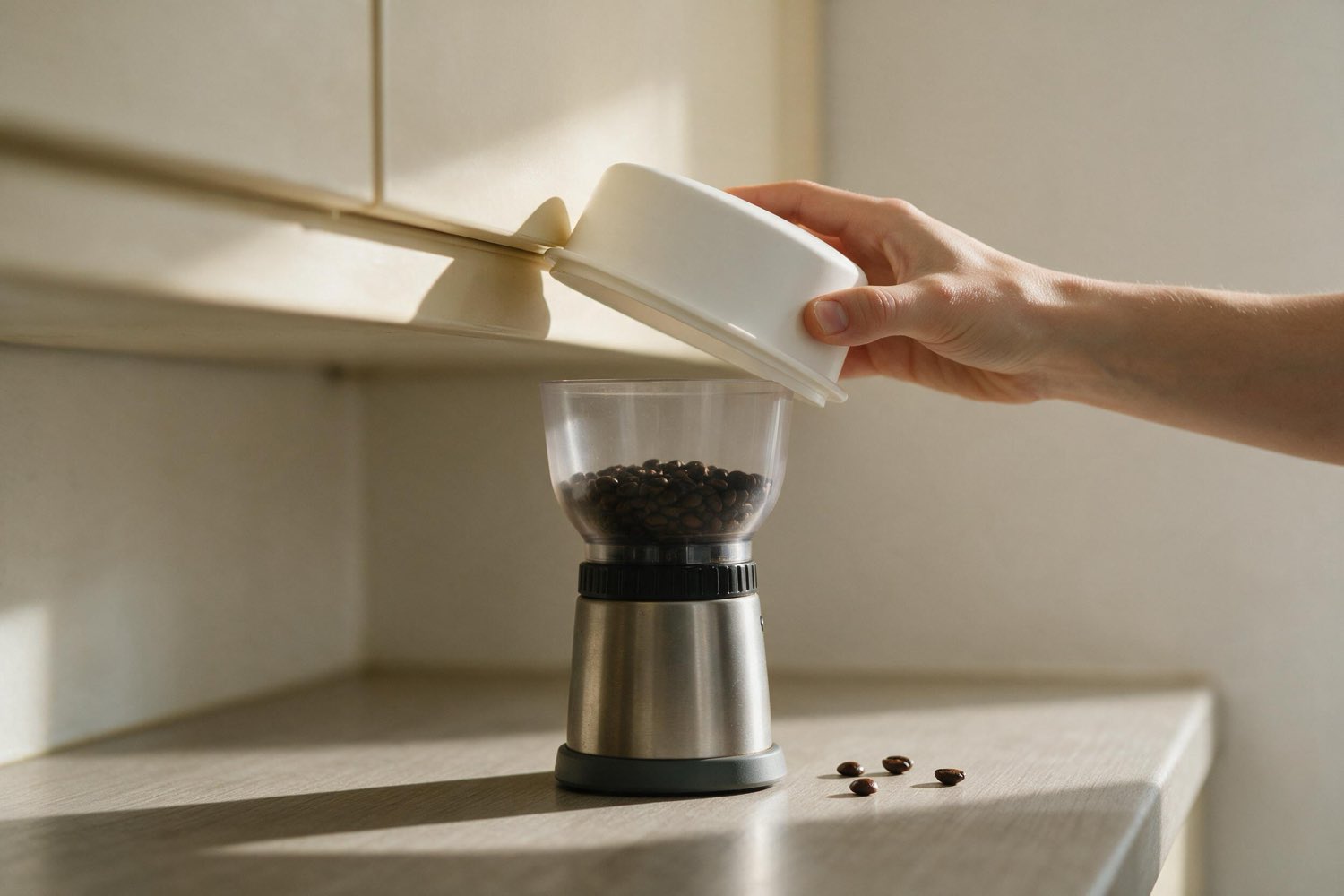
Eighteen inches disappears faster than you expect, because equipment does not stop at its own height:
- A pour-over stand needs its height, plus your hand, plus a kettle spout above that. A stand that measures sixteen inches does not work under an eighteen-inch cabinet. It just does not.
- A grinder’s hopper lid comes off upward. Its listed height is not its working height, and nobody publishes the working one.
- A top-fill reservoir needs the lid to open. That is another few inches, invisible in every product photograph ever taken.
Measure your gap. Subtract three inches before you compare it to anything. If what survives is under twelve, your setup wants to be a low one — an immersion brewer, a flat kettle, a hand grinder — and that is a perfectly good setup, not a consolation prize.
What earns a place on twenty-four inches
Four things. Everything else crowds the counter without changing what ends up in the cup.
The brewer
Under about eight inches wide, and it must work without a water line. Immersion and pour-over both qualify; the difference between them is how much of your morning attention the method wants, not how good the coffee can be. What disqualifies a brewer here is needing a foot of clearance for a lid you have nowhere to lift.
The grinder
Burr, not blade. A blade grinder chops; uneven grounds extract unevenly; the cup tastes muddy no matter how careful everything downstream is. Under six inches wide — and short enough that the hopper opens under your cabinet, which is the constraint everyone forgets until they are standing there holding a lid at an angle.
The kettle
Gooseneck if you are pouring over, because the pour rate is most of the technique. Whatever you choose, write down its wattage. You cannot do the arithmetic above without it, and it is the one number that is always printed and never read.
Somewhere for beans and filters
Inside the twenty-four inches, or vertically above them, and without a wall anchor. This is where a free-standing riser earns its keep: it turns one surface into two, and it comes apart when you move.
Three budgets, and what actually changes
These bands cover the essentials only — not tax, not shipping, not the optional pieces. We do not publish prices, because what a merchant charges today is not what it charges when you read this.
- Entry. Manual brewing, hand grinder, the kettle you own. Costs you a few minutes each morning and no counter space at all. This is a genuinely good setup. It is not the beginner version of a real one.
- Middle. A dedicated burr grinder and a temperature-control kettle. This is where consistency arrives — the same coffee twice in a row, which is what most people are actually chasing when they think they want better coffee.
- Upper. One machine that takes real estate. In twenty-four inches, space is the scarce resource, so the honest question is not whether something is better. It is whether it earns the inches it eats.
The trade-off nobody mentions
A burr grinder against a shared bedroom wall at six in the morning is loud. Not inconvenient-loud. The kind of loud that makes you grind the night before and drink slightly stale coffee — which quietly undoes the reason you bought the grinder.
If you share a wall with someone sleeping, that belongs in the decision. It is in almost none of the write-ups, and it is the reason at least some of those beautiful corners are photographed more often than they are used.
What it is like when it works
Here is the part that is hard to put in a specification. When the corner is right, you stop making decisions in the morning. You do not move the kettle to reach the beans. You do not open a cupboard with your elbow. You do not think about coffee at all — you just make it, and the thinking you were spending on logistics goes somewhere better.
Twenty-four inches is enough for that. It has to be the right twenty-four inches, measured, on a circuit you have checked, under a cabinet you have accounted for. But it is enough.
Why there are no product links on this page
Because we cannot stand behind them yet. We belong to no affiliate program, we have not verified a single model against a real retailer’s current listing, and a list assembled without that would read as researched while being nothing of the kind.
When there are picks here, each will say why it is in the setup, what it costs you elsewhere, and which of the measurements above it fails. Until then, this page is the part we can do honestly — the measuring and the arithmetic, which is what decides whether anything works, and what the prettier versions of this article leave out.
What we checked
- Small-appliance branch circuit requirement, and the refrigerator sharing it — National Electrical Code 210.52(B)(1) and 210.11(C)(1), 2020 edition, quoted above verbatim.
- Eighteen-inch counter-to-upper-cabinet clearance — NKBA Kitchen Planning Guidelines. A recommendation, not a code requirement, and stated as such.
- The wattage arithmetic is division. Repeat it with your own kettle.
- Not checked: any specific product. Which is why none is named.