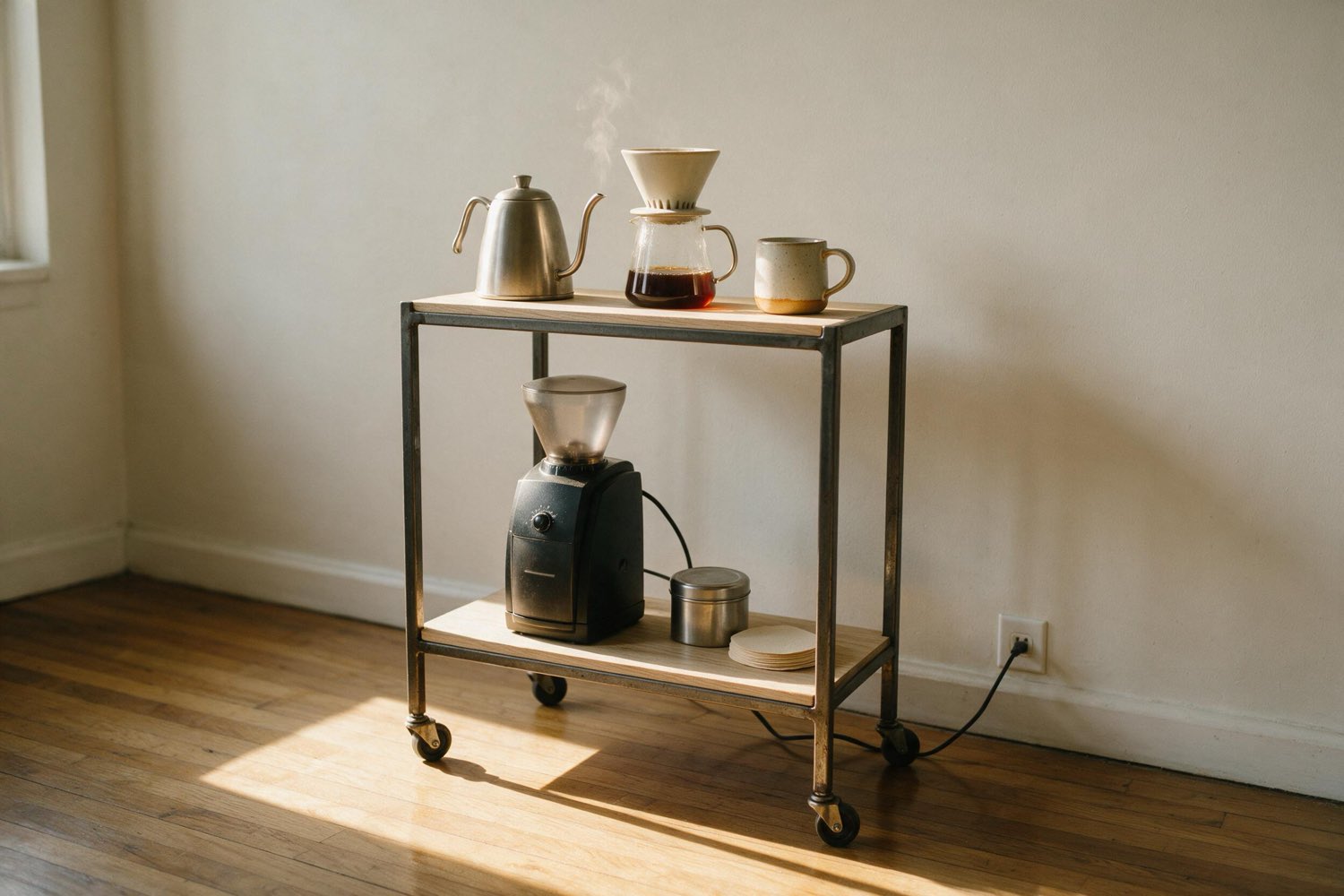
There is a version of this that has already happened to you or to someone you know. The kitchen had no free counter, so a cart arrived. For two weeks it was a coffee bar. Now it is a shelf with a kettle on it, parked somewhere it is slightly in the way, and the coffee gets made at the sink again.
That is not a failure of discipline. A cart solves the space problem by bringing its own surface, and in doing so it creates two problems that nothing in the product photograph warns you about. It moves. The outlet does not.
Both are solvable. Neither is solvable after you have bought the wrong cart.
Who this is for
- Every inch of your counter is counter you cook on.
- You would rather add furniture than give up cooking space.
- You are willing to decide where it lives when you are not using it — because that, not the coffee, is the actual constraint.
Who this is not for
- Anyone with a spare twenty-four inches of counter. A cart is a worse version of that. It wobbles, it collects things underneath, and it has to be pushed somewhere. If you have the counter, use the counter — we wrote that setup separately and it is the better one.
- Anyone whose only free floor is a walkway. You will carry boiling water past this thing in the dark.
- Anyone hoping it will also hold the mugs, the beans, the filters, the scale and the second grinder. It holds two of those and looks cluttered doing it.
The cable is the whole problem
A countertop setup plugs into a receptacle that a builder installed for appliances. A cart plugs into whatever is near where the cart fits, and those are rarely the same place. So the cable gets longer, or a power strip appears, and this is where a coffee cart becomes a different kind of object.
Do the division before you buy anything. A 1,500-watt kettle at 120 volts draws 12.5 amperes — watts over volts, and it matters more than anything printed on the box. A common household power strip is rated 15 amperes in total.
Twelve and a half of those fifteen are the kettle, alone, for as long as it is boiling. What is left over for everything else on that strip is two and a half amperes, and a grinder spinning up is not nothing.
That is not a rule we are quoting at you. It is arithmetic, and you can do it for your own kettle in ten seconds using the wattage printed on its base. Then do two things that are worth more than any article:
- Read the kettle’s own instructions. Appliances with heating elements often carry a line about plugging directly into a wall receptacle. That is the manufacturer speaking about their own product, which outranks us.
- If you must use an extension cord, use the shortest one that reaches, and check its amperage rating. Cords are rated too. The thin one you use for a lamp is not a cord for a kettle.
We are not electricians. If any of this is uncertain in your home, that is a question for one. What we can tell you is which number to look at, and that it is not the one on the front of the box.
It has to be stable enough to pour boiling water on
You will do this standing up, at height, possibly before you are properly awake. A cart that rocks is not a minor annoyance — it is the reason the cart stops being used.
- Put the weight low. The heaviest thing — usually the grinder — goes on the bottom shelf, not at working height. A cart is stable in proportion to how boring its top shelf is.
- Lock the casters, then push it and see. Two locking casters out of four is common, and is only enough when the two are diagonal.
- Carpet is not a floor for this. Small hard casters sink into pile. A cart you have to drag is a cart that lurches when it comes free.
- Read the per-shelf load rating, not the total. Manufacturers publish both. People read the total. The number that matters is what one shelf holds.
Measure the height, not just the footprint
People skip this because a cart looks like furniture rather than a workstation. A standard kitchen counter is around thirty-six inches. Plenty of carts are considerably lower — which means you pour down into a dripper instead of across at it.
That is fine once. By the second week it is a small daily tax on the thing you bought to enjoy. Measure the cart’s working surface, compare it to a counter you already like using, and if it is much lower, plan the top shelf to lift the brewer.
What earns space on a cart
Less than on a counter, because a cart has to stay upright and is visible from every side. The roles are the same as any small coffee setup. What changes is what disqualifies a candidate.
The brewer
Whatever suits your method, with one addition: it must not be top-heavy when full. A tall carafe on a narrow base is a different object on wheels than it is on granite.
The grinder
Burr, heavy, bottom shelf. Its weight is doing structural work down there. This is the one place in a small setup where “the heavy one” is an advantage rather than a cost.
The kettle
Write down its wattage before anything else. You cannot do the arithmetic above without it.
One closed container for everything that is not coffee
A cart accumulates. Give it somewhere to put things, and accept that anything without a home ends up on the top shelf, in the photograph, in the way.
What you are actually trading
Twenty-four inches of counter costs you counter you were not using. A cart costs you floor you were walking on — and in a small home, floor is the scarcest thing there is.
That can be a good trade. It is a good trade when the cart has a place to live that is not a doorway, when the cable reaches without an argument, and when the thing is steady enough that you do not think about it while pouring. It is a bad trade when the cart becomes furniture you edge around on the way to make coffee somewhere else.
Which of those you end up with is decided before you buy, by four measurements and one piece of division.
Why there are no product links on this page
We belong to no affiliate program, and we have not verified a single cart against a retailer’s current listing. When there are picks here, each will say what it costs you and which of the checks above it fails.
What we checked
- The electrical figures are arithmetic, not a citation: 1,500 W at 120 V is 12.5 A, and a common household power strip is rated 15 A in total. Repeat both with your own kettle.
- We looked for an authoritative statement that a kettle must never go on a power strip and did not find one we could stand behind — so this page does not make that claim. It shows you the division instead.
- Standard US counter height, approximately thirty-six inches: widely used industry figure, stated as approximate.
- Not checked: any specific cart, its load rating, or its casters. Which is why none is named.